Our Strategic Vision.
Elevating Global Cyber Maturity via Small and Medium-Sized Business (SMB) Uplift
With SMBs making up over 90% of global economies, their cyber maturity is crucial to economic resilience.
With SMBs making up over 90% of global economies, their cyber maturity is crucial to economic resilience.
This is evidenced in the policy and support efforts of leading developed nations. For example, the US National Institute of Standards and Technology’s Small Business Cybersecurity Corner, Singapore’s ongoing SME Go Digital program that includes cybersecurity solutions, and the European Union Agency for Cybersecurity’s guidance.
This white paper captures Dynamic Standards International (DSI)’s strategy to leverage a government-backed, industry-led whole-of-country solution to the SMB cybersecurity uplift challenge. We studied lessons from existing approaches, and distilled a list of nine elements which will catalyze global uplift of the SMB sector:
1. SMBs can easily implement the guidance.
2. IT providers can support and deliver for their SMB customers.
3. A solution that aligns with common cybersecurity frameworks.
4. A solution comprising of multiple levels to enable progressive maturity uplift.
5. A solution that incorporates essential risk management activities appropriate for SMBs.
6. A solution that can be used for certification so that SMBs can articulate their cyber maturity.
7. A solution that is cost affordable for SMBs.
8. A solution that requires director involvement e.g. director attestation.
9. A solution which is regularly updated to the latest cyber threat landscape.
When these nine elements are addressed, DSI’s hypothesis is that a nation will uplift SMB cyber maturity at scale, at minimal cost to the government and the SMBs. DSI’s five-level SMB1001 ‘Multi-tiered cybersecurity certification standard for small and medium-sized businesses’ (SMB1001) serves as the taxonomy for SMBs, governments and large enterprises to communicate at a common easy-to-understand language. Through examples and use cases, the document also explains how DSI’s approach leverages procurement processes to facilitate natural widespread adoption and incentivization of SMB cyber investment, without needing to legislate director responsibilities.
DSI’s approach leverages the natural flow of day-to-day economics. For example, with SMB1001’s levels clearly defined and refreshed annually by industry experts, buyer organizations will now be able to request for non-sensitive suppliers to be at SMB1001 Level 1 while their sensitive suppliers are requested to be certified against Level 3 and above. Since Level 1 certification only starts at USD95, suppliers to these buyer organizations will be able to kickstart their cyber maturity journey. When this is executed at scale across supply chains, the possibility of uplifting the cyber resilience of economies is definitely achievable.
In the wake of increasing cybersecurity challenges and threats, we recognize the pivotal role of small and medium-sized businesses (SMBs) as the backbone and powerhouse for global cyber maturity, we propose a pragmatic transformative strategy that facilitates nationwide delivery.
Supply chain cyber risk management is a key concern in business ecosystems. In essence, supply chain cyber risk management recognizes that if one business in a supply chain suffers a cyber incident, it may have repercussions for the remainder of the supply chain. For instance, the 2013 Target data breach where attackers compromised Fazio Mechanical, a third-party contractor, allowing attackers to infiltrate and install malware on Target’s point of sales systems [5]. The financial impact of this attack was severe with an estimated cost of over USD$202 million [9], More recently, the SolarWinds attack in 2020 gained access to the systems and data of SolarWinds’ customers exposing the customers [8]. It is then critical that supply chain cyber risk is managed to avoid having business data and systems exposed because of a supplier’s vulnerabilities. Effective supply chain cyber risk management will require the cybersecurity of the entire supply chain. There also needs to be trust between the parties in the supply chain that other parties have implemented suitable controls. Further, securing the supply chain is not limited to the larger businesses but should extend to include all business, e.g. SMBs.
The importance of small to medium-sized businesses is also recognized by governments globally with the resilience of these businesses becoming a focus for cybersecurity. For instance, the 46th U.S. President Joe Biden [4] noted that “small businesses are the engines of our economic progress”.
Implementing cybersecurity is then critical for SMBs for the cybersecurity of business ecosystems. However, SMBs are not frequent implementors of mature cybersecurity despite the frequency of cyber incidents experienced. According to the UK Cybersecurity Breaches Survey [14], 47% of surveyed micro businesses and 58% of surveyed small businesses had suffered an incident in the past 12 months.
The lagging cybersecurity maturity of SMBs despite their importance in supply chains and the frequency of cyber incidents experienced may be caused by the cost of cybersecurity, the lack of realizable economic incentive and the limited availability of clear implementable guidance. It is then a priority to uplift global SMB cybersecurity through uplifting nationwide SMB cybersecurity. However, while many nations recognize and have attempted nationwide SMB cybersecurity uplift, to the best of our knowledge, there has not been a scheme which has received widespread adoption by SMBs.
To address this lagging maturity, we suggest that a scheme is needed to change how cybersecurity is presented to SMBs. We propose that market forces need to be leveraged to ensure SMBs act i.e. through procurement-driven or legislative requirements.
In this white paper, we present DSI’s pragmatic transformative strategy that facilitates nationwide delivery and uplift of SMB cybersecurity. We also contextualize DSI’s strategy by reflecting on the lessons learned from existing schemes and clarifying the characteristics of an effective scheme or solution.
Even though cybersecurity is recognized as a key issue for businesses with guidance generally available, widespread adoption by SMBs is not always observed. Reasons behind this limited adoption, based on empirical evidence, indicates that this may be caused by the limited specific guidance available, and the lack of realizable economic incentive for adopting cybersecurity.
2.1 Challenge 1: No fit-for-purpose cybersecurity certification for SMBs
Even though there is substantial cybersecurity guidance and certification available, it tends to be difficult for SMBs to implement. This difficulty may be caused by the cost required and/or complexity of the guidance. According to Mastercard [6], 47% of their surveyed businesses found cost to be an issue preventing cybersecurity adoption. In addition, it was felt by 68% of the surveyed businesses [6] that clear guidance would be beneficial.
One of the most common cybersecurity guidance and certifications available is ISO/IEC 27001. Despite its strength in helping businesses develop secure information management systems, it is accepted that it can be difficult for SMBs to implement. This is especially true if the SMB is beginning their cybersecurity journey.
Though existing guidance and certifications can be adapted for SMBs, it can be difficult for SMBs to determine how to adapt the guidance and certifications to fit their business. For instance, segregation of duties is a typical control recommended by cybersecurity guidance. However, if an SMB only has an employee for each role with no duplicates, segregation of duties can be difficult to implement without adding complexity to employees’ duties and the business overall. Segregation of duty would then be a less important control compared to having access controls, such as multi-factor authentication, etc.
There is then a need for guidance and certification that is fit-for-purpose for SMBs.
2.2 Challenge 2: Driving SMB uplift engagement
Even if the above challenge is addressed, it is uncertain whether SMB uplift will occur. This may be caused by the perceived cost of cybersecurity in contrast to the economic benefit of investing in cybersecurity.
Even though most SMBs recognize the importance of cybersecurity, the cost of cybersecurity can be difficult for SMBs to justify. According to [15], many small businesses believe cybersecurity is too expensive.
Considering that most businesses are focused on generating revenues, it can be difficult to encourage cybersecurity uplift if there is no definite economic benefit for businesses. Solely relying on the narrative that it will help their business if they suffer an incident is not sufficient considering fluctuating economic conditions that affect consumer spending. For SMBs, the need for a realizable economic benefit is essential as decisions to invest in cybersecurity can cost investment in generating revenues or the business continuing.
It is then critical to provide an economic incentive to encourage cybersecurity uplift for SMBs. Otherwise, SMBs may not be motivated to invest in cybersecurity.
Considering the current challenges, any solution needs to address these challenges, namely, develop a fit-for-purpose cybersecurity certification that leverages realizable economic incentives. In addition, an ideal solution for SMB cybersecurity uplift through guidance should, based on our experience, have the following characteristics:
1. SMBs can easily implement the guidance.
2. IT providers can support and deliver for their SMB customers.
3. A solution that aligns with common cybersecurity frameworks.
4. A solution comprising of multiple levels to enable progressive maturity uplift.
5. A solution that incorporates essential risk management activities appropriate for SMBs
6. A solution that can be used for certification so that SMBs can articulate their cyber maturity.
7. A solution that is cost affordable for SMBs.
8. A solution that requires director involvement e.g. director attestation
9. A solution which is regularly updated to the latest cyber threat landscape.
For the first characteristic, it is essential that SMBs are able to understand what is expected so they can implement the guidelines. This also addresses the findings from surveys, such as a recent survey by [6].
Regarding the second characteristic, IT providers (e.g., Managed Service Providers (MSPs)) can support and deliver, this is needed to ensure that the solution is fit-for-purpose. Typically, SMBs rely on IT providers to support their cybersecurity implementation [1]. It is important that IT providers can interpret and apply the guidance to help SMBs in implementing cybersecurity. Therefore, any solution needs to be workable for IT providers as well.
There are a number of major cybersecurity frameworks available. It is important, considering the supply chain cyber risk perspective, that any SMB solution is compliant, at least, with the recommendations of these major cybersecurity frameworks. This allows a consistent cybersecurity approach across the business ecosystem.
In terms of the solution, it needs to be multi-tiered to recognize SMBs are diverse (e.g., from a sole proprietor tradesperson to a small accounting or healthcare company, to a medium sized law practice). Therefore, SMBs may have different needs and capacity for cybersecurity. Some SMBs may need different cybersecurity maturity due to the type of data they process or store. In addition, a multi-tiered approach recognizes that cybersecurity is an ongoing journey and is not a one-stop event.
The solution should also be designed to incorporate risk management principles, and updated to help SMBs prevent the latest cyber threats (e.g., invoice frauds). This embeds flexibility into the solution allowing SMBs to then adapt their cybersecurity considering the risks they face.
Based on the above discussion of the importance of economic incentives, any solution should leverage economic incentives to encourage adoption of the solution. The easiest way to achieve this is by providing some output that SMBs can use, e.g. a certification. This certification can demonstrate that an SMB has implemented cybersecurity controls and can be used when SMBs need evidence of their cybersecurity.
Finally, in light of existing research, it is important to have director support and involvement for cybersecurity. Their support is essential as they support the management of the business and can set the tone on how cybersecurity is perceived in the business. This may be through receiving reports or engaging in discussions, where relevant. It is critical that any solution involves directors to ensure they support the solution.
The need for cybersecurity uplift is a global challenge. Hence, there have been considerable strides made globally in developing solutions to uplift cybersecurity for SMBs. In this section, an overview of the relevant solutions for SMBs is provided. In addition, a mapping of the described schemes to the characteristics of an ideal solution presented above are provided.
The UK’s Cyber Essentials is a cybersecurity scheme developed by the United Kingdom’s National cybersecurity Centre. As part of this scheme, an organization can complete a self-assessment of their organization (Cyber Essentials) or have a technical verification of their organization (Cyber Essentials Plus) [2].
The self-assessment and verification of an organization’s cybersecurity is conducted in relation to these five control areas:
Despite the strength and the accessibility of the Cyber Essentials scheme, its adoption is lagging. At 22 June 2023, 132,094 Cyber Essential Certificates were issued since the scheme commenced in 2014.
This lagging adoption may be caused by the lack of awareness of Cyber Essentials and the cost barrier for SMBs. A recent report by the United Kingdom Department of Science, Innovation and Technology [13] indicated that only 14% of businesses were aware of Cyber Essentials. Though, a larger percentage of medium and larger businesses were aware of Cyber Essentials compared to the percentage of smaller businesses [13]. It was also noted by industry that the cost (approximately £390 – 650 depending on size) may be a barrier for smaller businesses [7].
However, much of the current adoption of the scheme appears to be driven by the requirement to have Cyber Essentials certification for public sector contracts [13]. This reflects the benefit of procurement-driven certification.
In 2022, the cybersecurity Agency of Singapore (CSA of Singapore) released a cybersecurity certification program with two types of certification: Cyber Essentials and Cyber Trust. Both levels incorporate risk management [10]. Cyber Essentials is the first type of certification for basic cyber hygiene measures. Cyber Trust is more complex requiring businesses to implement additional cybersecurity controls. In addition, a yearly audit must be completed [10]. According to the CSA of Singapore, Cyber Essentials is suitable for small and medium enterprises [11] whereas Cyber Trust is more suitable for larger and more digitally advanced organizations. This could mean that once an SMB meets Cyber Essentials, there is then little incentive to continue maturing their cybersecurity over the following years. To the best of our knowledge, it also does not cover the SMB diversity in their needs or capacity in detail. Hence, some SMBs may prefer to have a higher level of maturity.
For Cyber Essentials, businesses need to implement controls relating to:
Most of the controls focus on documentation of processes or information [11]. This is useful in helping SMBs start implementing cybersecurity.
The domains for Cyber Trust have specific controls relating to governance/oversight, education, information asset protection, secure access and environment, and resilience. These five control areas are then grouped based on the level of complexity and association with cybersecurity maturity into five tiers that build on each other: Supporter, Practitioner, Promoter, Performer and Advocate.
There are currently 97 businesses that have been certified with Cyber Essentials at 8 December 2023 [12]. 40 businesses have been certified at the different tiers for Cyber Trust at 8 December 2023 [12]. The majority of these 40 businesses have certified at the highest level of Advocate tier [12].
The adoption of the Cyber Trust certification has been aided by the funding support provided by CSA of Singapore [10]. In addition, other benefits for certification are included e.g. discounted insurance rates [11]. For Cyber Essentials, a cybersecurity excellence award has been created for SMBs. An award can motivate SMBs to adopt cybersecurity.
This funding and additional benefits provided by CSA have incentivized the option of cybersecurity certification helping to encourage adoption by businesses.
The United States’ Department of Defense has also developed a certification program. This program was developed to support defense businesses, specifically defense industrial base, in developing mature cybersecurity that matches the requirements of the Department of Defense [3].
CMMC is a tiered certification comprising of three levels [3]. For Level 1, it can be self-attested. Level 2 and 3 are attested using third-party or government assessment respectively [3]. Each level builds on each other leading to over 110 requirements at Level 3. There are only 15 requirement at Level 1.
At Level 1, controls focus on:
It is planned that CMMC certification will be required for Department of Defense suppliers handling sensitive and unclassified information [3]. Currently, it is required for specific contracts.
Table 1: Mapping of existing certification schemes to characteristics of an ideal solution to uplift cybersecurity
UK CYBER ESSENTIALS:
✅ PotentiallySINGAPORE CYBER ESSENTIALS:
✅ YesSINGAPORE CYBER TRUST MARK:
❌ NoUK CYBER ESSENTIALS:
✅ YesSINGAPORE CYBER ESSENTIALS:
✅ YesSINGAPORE CYBER TRUST MARK:
❌ NoUK CYBER ESSENTIALS:
✅ SomewhatSINGAPORE CYBER ESSENTIALS:
✅ SomewhatSINGAPORE CYBER TRUST MARK:
✅ YesUK CYBER ESSENTIALS:
✅ YesSINGAPORE CYBER ESSENTIALS:
❌ NoSINGAPORE CYBER TRUST MARK:
✅ YesUK CYBER ESSENTIALS:
❌ NoSINGAPORE CYBER ESSENTIALS:
✅ YesSINGAPORE CYBER TRUST MARK:
✅ YesUK CYBER ESSENTIALS:
✅ YesSINGAPORE CYBER ESSENTIALS:
✅ YesSINGAPORE CYBER TRUST MARK:
✅ YesUK CYBER ESSENTIALS:
✅ SomewhatSINGAPORE CYBER ESSENTIALS:
✅ YesSINGAPORE CYBER TRUST MARK:
❌ NoUK CYBER ESSENTIALS:
❌ NoSINGAPORE CYBER ESSENTIALS:
❌ NoSINGAPORE CYBER TRUST MARK:
❌ NoUK CYBER ESSENTIALS:
❌ NoSINGAPORE CYBER ESSENTIALS:
❌ NoSINGAPORE CYBER TRUST MARK:
❌ NoConsidering the challenges identified in Section 2, the characteristics of an ideal solution in Section 3 and the lessons learned from Section 4, we have developed a strategy that can transform the process of uplifting SMB cybersecurity.
Overview of strategy
DSI’s tailored approach, anchored by a SMB-focused certification (SMB1001) and platform for certification (CyberCert) programs, promises to elevate cyber hygiene through accessible certification, driving industry standards and enabling a robust economic incentive model. By integrating a ’ticket to trade’ philosophy, we aim to catalyze SMBs’ cyber defences, powered by a cost-effective, scalable path to cyber resilience that aligns with government and large enterprises’ supply chain mandates.
We acknowledge that voluntary measures alone can fall short; thus, we advocate for legislative change to include small and medium business compliance with SMB1001 via relevant instruments. This strategic push will bring about market forces and influence as those certified SME businesses see competitive advantage over those that are not certified, thus ensuring a collective uplift in cybersecurity across all levels - from government to individual awareness.
Providing this strategic push will help ensure that there is uplift of SMB cybersecurity with DSI’s goal of having 250,000 SMBs globally at SMB1001 Level 1 or higher level by 2027. The flow on benefits of uplifting SMB cybersecurity is that it will help make our business ecosystems more secure and support countries in their goals for cybersecurity.
However, providing this strategic push needs the support of the entire ecosystem. In Figure 1, it shows how the different stakeholders in the ecosystem support the execution of DSI’s strategy.
Figure 1: Overview of potential ecosystem interactions
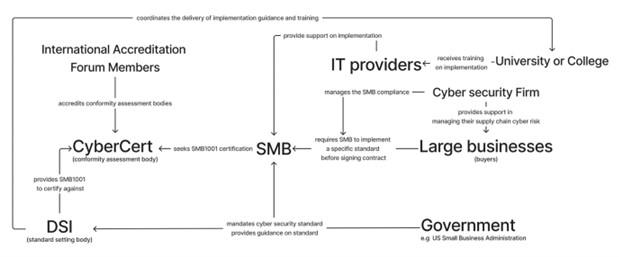
For instance, the SMB-focused standard-setting body, e.g. DSI, will develop SMB1001 and update the standard annually via feedback rounds from SMBs, and experts from government and industry. This standard is then available as a certification, which will be administered by conformity assessment bodies, such as CyberCert. The conformity assessment bodies are accredited by a relevant International Accreditation Forum member following the guidelines prepared by DSI.
SMBs will adopt the standard because it is a good thing to do, and also due to market forces. For example, the standard could be required by buyers, recommended by government or experts, or mandated by insurance companies or industry organizations, or to assist in compliance with legal obligations.
Support will be provided to SMBs implementing SMB1001 through IT providers or by internal IT departments. In both instances, IT providers or IT departments may have completed Lead Implementor courses from universities or colleges. If SMBs choose to complete the higher levels of SMB1001, they will use independent verification organizations to verify that they have implemented the controls.
Supplier Cyber Assurance Program (SCAP)
In DSI’s strategy, we propose using a procurement-driven approach: Supplier Cyber Assurance Program (SCAP). SCAP is a whole-of-supply-chain cyber risk management program that allows suppliers to provide assurance of their cybersecurity to buyers through cybersecurity certifications. Using certifications to provide assurance of their cybersecurity eases the process for buyers and their supply chain cyber risk management. Hence, buyers are more willing to work with suppliers who have certifications.
Using SCAP can create an economic incentive for SMBs. In a way, certification of their cybersecurity becomes their “ticket to trade”. Similar to the impact of professionalization, a ‘ticket to trade’ can be essential for SMBs to remain competitive. It can be made further relevant if larger businesses, e.g. buyers, indicate that they prefer to work with SMBs with higher maturity.
In addition, this ‘ticket to trade’ is more straightforward than an SMB completing lengthy questionnaires as part of typical supply chain cyber risk management. An SMB only needs to complete assessment, attestation by director and pay the certification fee.
SMB1001
For SMB suppliers, this SCAP leverages DSI’s developed fit-for-purpose standard for SMBs: SMB1001. The current version is SMB1001. DSI’s standard is multi-tiered comprising of five levels beginning at Level 1 (Bronze). Each level builds on the previous level with additional controls or complexity added.
The controls included in DSI’s standard are mapped to existing frameworks and guidelines, such as ISO/IEC 27001:2022, while being appropriate for SMBs. The standard is capable of being certified against with the requirements stating that a director must attest that the controls are implemented. At higher levels, external verification is needed.
An overview of how DSI’s standard maps to the characteristics of an ideal solution are provided in Table 2.
Table 2: Mapping of SMB1001 to characteristics of an ideal solution to uplift cybersecurity
SMB1001:
✅ Tailored-made for SMBsSMB1001:
✅ Our first control requires the involvement of IT providersSMB1001:
✅ SMB1001 incorporates the controls from different frameworksSMB1001:
✅ SMB1001 consists of five levelsSMB1001:
✅ SMB1001 written in a language accessible to all parts of the economy.SMB1001:
✅ SMB1001 is available for certificationSMB1001:
✅ SMB1001 and the certification are priced affordably. Level 1 is priced at $95.SMB1001:
✅ Certifying against any levels requires directors’ attestationSMB1001:
✅ SMB1001 Steering Committee mem- bers feedback latest mitigation approaches for the emerging cyber threats, and updates the standard annually.Low-cost, self-service certification
A secondary part of our strategy involves using an online conformity assessment body that can provide a low-cost, self-service certification platform for SMBs that is easily scalable. DSI has accredited CyberCert as the first Dynamic Standard Certifier and certification issuer that will provide SMB1001 cybersecurity certification services for businesses. SMBs will interact directly with CyberCert’s platform.
SMBs can use CyberCert (https://cybercert.ai) to complete their entire certification process from downloading their requirement workbooks, to completing their conformity check list and director attestation.
For higher level certifications that require verification, businesses can choose from several Independent Verification Organizations (IVO) that will provide the necessary audit services as part of the business’ certification subscription with CyberCert. Once SMBs are certified, they can share their certifications with any buyers, and in any of their marketing material.
CyberCert is also available to administer SCAP programs and other assessments.
SMB cybersecurity uplift is a key issue critical to the ability to manage supply chain cyber risks. Considering current challenges for SMBs, we have developed a validated, ready-to-go solution that in collaboration with governments globally will transform SMB cybersecurity.
To see significant SMB cybersecurity uplift, the journey begins with two decisive steps: endorsing SMB1001 and forging a partnership with CyberCert. Together, we can safeguard SMBs digital future, ensuring that by 2027, over 250,000 entities will stand stronger, at Level 1 certification or higher.
[1] Acronis. In cyberattacks, SMBs face an existential threat. Acronis. 2021. URL: https://www.acronis.com/en-sg/cyber-protection-center/posts/cyberattacks-smbs-face-existential-threat/. (Visited on 10/09/2024).
[2] National Cyber Security Centre. Cyber Essentials Overview. National Cyber Security Centre. URL: https://www.ncsc.gov.uk/cyberessentials/overview.
[3] U.S. Department of Defense. About CMMC. dodcio.defense.gov. URL: https://dodcio.defense.gov/CMMC/about/.
[4] The White House. Remarks by President Biden on Helping Small Businesses | The White House. The White House. Feb. 2021. URL: https://www.whitehouse.gov/briefing-room/speeches-remarks/2021/02/22/remarks-by-president-biden-on-helping-small-businesses/. (Visited on 10/09/2024).
[5] Michael Kassner. Anatomy of the Target data breach: Missed opportunities and lessons learned. ZDNet. 2015. URL: https://www.zdnet.com/article/anatomy-of-the-target-data-breach-missed-opportunities-and-lessons-learned/.
[6] Mastercard. New Data Reveals Up to 309,000 Australian small businesses say they’ve been targeted by cyberattacks, yet many are forced to cut cybersecurity costs. Mastercard.com. Nov. 2023. URL: https://www.mastercard.com/news/ap/en/newsroom/press-releases/en/2023/new-data-reveals-up-to-309-000-australian-small-businesses-say-they-ve-been-targeted-by-cyberattacks-yet-many-are-forced-to-cut-cybersecurity-costs/. (Visited on 10/09/2024).
[7] M Maundrill. Survey: Information security’s relationship with UK Cyber Essentials. Infosecurityeurope.com. 2023. URL: https://www.infosecurityeurope.com/en-gb/blog/regulation-and-policy/uk-cyber-essentials-survey-results.html. (Visited on 10/09/2024).
[8] Saheed Oladimeji and Sean Michael Kerner. SolarWinds hack explained: Everything you need to know. Techtarget. Nov. 2023. URL: https://www.techtarget.com/whatis/feature/SolarWinds-hack-explained-Everything-you-need-to-know.
[9] S Ramakrishnan and N Bose. Target in $18.5 million multi-state settlement over data breach. Reuters. 2017. URL: https://www.reuters.com/article/idUSKBN18J2KT/#:~:text=Target%20also%20said%20the%20total,action%20settlement%20that%20is%20outstanding.
[10] Cyber Security Agency of Singapore. Certification for the Cyber Essentials mark. Cyber Security Agency of Singapore. URL: https://www.csa.gov.sg/our-programmes/support-for-enterprises/sg-cyber-safe-programme/cybersecurity-certification-scheme-for-organisation/cyber-essentials/certification-for-the-cyber-essentials-mark. (Visited on 10/09/2024).
[11] Cyber Security Agency of Singapore. CSA launches new cybersecurity certification programme to recognise enterprises with good cybersecurity practices. Cyber Security Agency of Singapore. 2022. URL: https://www.csa.gov.sg/News-Events/Press-Releases/2022/csa-launches-new-cybersecurity-certification-programme-to-recognise-enterprises-with-good-cybersecurity-practices. (Visited on 10/09/2024).
[12] Cyber Security Agency of Singapore. List of Cyber Essentials Certified Organisations. . 2023. URL: https://www.csa.gov.sg/docs/default-source/our-programmes/support-for-enterprises/sg-cyber-safe-programme/20231208-list-of-companies-certified.pdf?sfvrsn=b828d1c11. (Visited on 10/09/2024).
[13] UK Department for Science, Innovation and Technology. Cyber Security Breaches Survey 2023. GOV.UK. Apr. 2023. URL: https://www.gov.uk/government/statistics/cyber-security-breaches-survey-2023/cyber-security-breaches-survey-2023.
[14] UK Department for Science, Innovation and Technology. Cyber security breaches survey 2024. UK Government. Apr. 2024. URL: https://www.gov.uk/government/statistics/cyber-security-breaches-survey-2024/cyber-security-breaches-survey-2024#chapter-4-prevalence-and-impact-of-breaches-or-attacks.
[15] Verizon. The truth behind 5 small business cybersecurity misconceptions. Verizon Business. Jan. 2024. URL: https://www.verizon.com/business/resources/articles/s/truth-behind-5-small-business-cybersecurity-misconceptions/. (Visited on 10/09/2024).